
San Salvador, El Salvador, April 27, 2026: The countries of the Central American Integration System (SICA) have defined the monitoring framework for their 2025-2027 Energy Strategy, a mechanism that will measure regional progress on issues such as energy matrix diversification, climate resilience, universal access to electricity, and energy efficiency. Participating countries are Belize, Guatemala, El Salvador, Honduras, Costa Rica, Panama, and the Dominican Republic.
The Energy Coordination Unit of the General Secretariat of the Central American Integration System (UCE-SGSICA), together with the United Nations Industrial Development Organization (UNIDO) and the Global Network of Regional Sustainable Energy Centres (GN-SEC), with the support of the Austrian Development Agency (ADA), is advancing the monitoring process for the 2025-2027 period of the 2030 Sustainable Energy Strategy (EESCA-SICA).
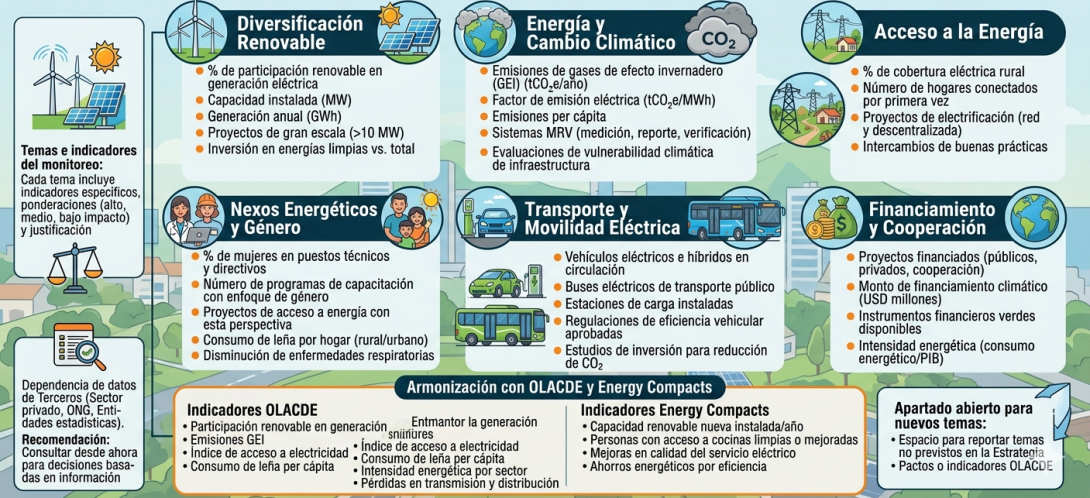
Monitoring Themes and Indicators
The report structures 13 monitoring areas. Among them, Data Management, Renewable Diversification, Energy and Climate Change, Regulation and Standardization, and Financing are core parts of the monitoring. Also included are Energy Education, Sustainable Transport, Energy Nexus, Energy Access, and Rational and Efficient Energy Use.
Each theme includes specific indicators, weightings (high, medium, or low impact), and spaces for justification and observations.
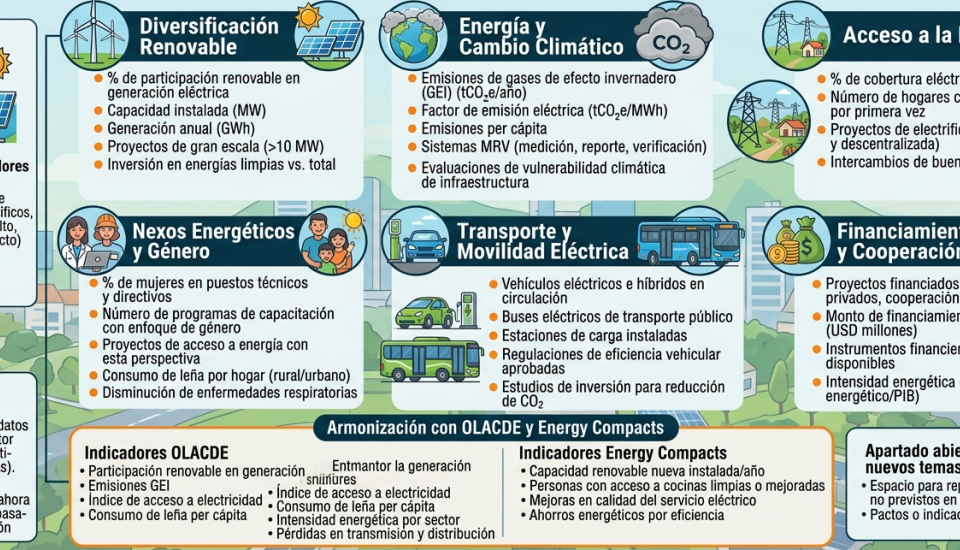
Renewable Diversification
The percentage of renewable participation in electricity generation, installed capacity (MW), annual generation (GWh), large-scale projects (>10 MW), and investment in clean energy relative to the total will be measured.
Climate Change and Emissions
Countries will measure greenhouse gas emissions from the energy sector (tCO₂e/year), electricity emission factor (tCO₂e/MWh), per capita emissions, the existence of MRV systems (measurement, reporting, and verification), and climate vulnerability assessments of energy infrastructure.
Energy Access
Indicators aim to close rural gaps: percentage of rural electricity coverage relative to total rural population, number of households connected to electricity for the first time, rural electrification projects (grid and decentralized), and exchanges of good practices between countries.
Energy Nexus and Gender
This theme strongly incorporates, for the first time, gender indicators: percentage of women in technical/management positions in the energy sector, number of energy training programs aimed at women, and energy access projects implemented with a gender perspective. It will also measure firewood consumption per household (disaggregated by rural/urban) and the reduction of respiratory diseases in intervened communities.
Transport and Electric Mobility
For the transport sector, the following will be counted: electric and hybrid vehicles in circulation, electric public transport buses, installed charging stations, regulations approved for vehicle energy efficiency, and investment studies for CO₂ reduction.
Financing and Cooperation
The monitoring will evaluate resource mobilization: number of energy projects financed with public, private, or international cooperation funds; amount of international climate finance directed to the energy sector (USD million); available green financial instruments; and energy intensity (energy consumption / GDP).
The document warns that many indicators depend on other institutions (private sector, NGOs, statistical agencies), and therefore recommends “making inquiries now, to make decisions based on access to information.”
Harmonization with OLADE and Energy Compacts
In addition, EESCA 2025-2027 will incorporate indicators recommended by OLADE (Latin American Energy Organization) and the Energy Compacts Progress Report. The former include renewable share in generation, GHG emissions, electricity access index, per capita firewood consumption, energy intensity by sector, and transmission and distribution losses. From the Energy Compacts, the following will be included: new renewable capacity installed per year, people with access to clean or improved cookstoves, improvements in quality of electricity service, and annual energy savings achieved through energy efficiency measures.
Finally, the monitoring will include an open section for each country to report new topics not foreseen in the Strategy, the Compacts, or the OLADE indicators.
The monitoring exercise seeks to ensure compliance with SDG target 7.2 (substantially increasing the share of renewable energy) and to guide regional energy policies toward resilient, low-emission, and gender-equitable systems.


Latest News
-
ECREEE Strengthens the Capacities of Clean Energy SMEs 
ECREEE Strengthens the Capacities of Clean Energy SMEs
-
ECOCONF Validates Regional Solar PV Certification Framework 
ECOCONF Validates Regional Solar PV Certification Framework
-
ECREEE and Partners Advance Sustainable Food Systems through AGRI-COOL 
ECREEE and Partners Advance Sustainable Food Systems through AGRI-COOL
-
ECREEE and IEC Explore Opportunities for Cooperation 
ECREEE and IEC Explore Opportunities for Cooperation
-
Empower Her Future - Call for Role Models 
Empower Her Future - Call for Role Models
-
ECOWAS Concludes Regional Workshop in Lomé on Energy Efficiency Indicators and Data Validation 
ECOWAS Concludes Regional Workshop in Lomé on Energy Efficiency Indicators and Data Validation
-
ECOWAS Audit Committee Pays Courtesy Visit to ECREEE 
ECOWAS Audit Committee Pays Courtesy Visit to ECREEE
-
ECREEE Promotes Integrated Approach to Sustainable Energy and Water Management in West Africa 
ECREEE Promotes Integrated Approach to Sustainable Energy and Water Management in West Africa
-
ReCCAWA Steering Committee meets in Abuja and adopts the 2026 work plan 
ReCCAWA Steering Committee meets in Abuja and adopts the 2026 work plan
-
The Role of Sustainable Energy Centres in Promoting Climate Resilience, Innovation and Energy Transitions Discussed 
The Role of Sustainable Energy Centres in Promoting Climate Resilience, Innovation and Energy Transitions Discussed
-
Gibson Okezie Obasi Appointed Executive Director of ECREEE 
Gibson Okezie Obasi Appointed Executive Director of ECREEE
-
Eswatini to Host the 3rd SADC Sustainable Energy Week: Join Southern Africa’s Premier Sustainable Energy Platform 
Eswatini to Host the 3rd SADC Sustainable Energy Week: Join Southern Africa’s Premier Sustainable Energy Platform